
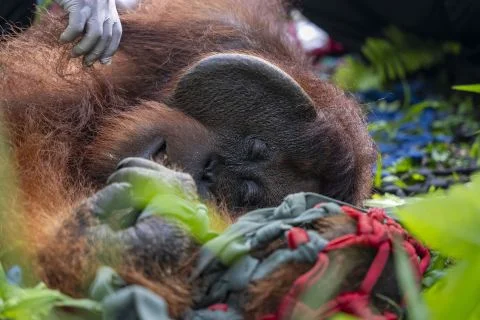
On 23 April an orangutan was successfully moved from a plantation area in the Kayong Utara Regency to a more natural environment in Gunung Palung National Park, thanks to a collaborative effort between YIARI, several government agencies* and the help of the local community.
It all began with community reports of an orangutan’s presence in the area. The same orangutan had been observed crossing coconut and rubber plantations owned by residents late last year. However, over the past week, it had begun to settle in the coconut plantation, causing concern among the community, particularly due to its large size.
Muhadi, Assistant Manager of YIARI’s Orangutan Protection Unit, emphasised that the translocation was a final step taken after various other management options had been carefully considered.
He explained that translocation isn’t simply moving orangutans but rather returning them to a safer and more suitable natural habitat. “This step is taken to ensure the safety of the orangutans while reducing the potential for conflict with humans. Based on the assessment results and the existing landscape conditions, the presence of these orangutans poses a risk of economic loss and fear, which could lead to actions that are dangerous for both animals and humans,” Muhadi explained.
The rescue coalition moved to the location early in the morning around 7:00 a.m. Western Indonesian Time (WIB) to carry out a planned evacuation. A member of YIARI used a tranquiliser gun to sedate the orangutan and minimise the risks. The anaesthetic dose was carefully calculated by a veterinarian based on the animal’s estimated weight, and it was administered by officially licensed personnel.
A medical examination of the orangutan revealed natural wounds on the face and left arm, as well as fractured teeth. “These wounds were likely caused by the surrounding environment, such as bamboo bushes, considering that this orangutan spends a lot of time in gardens and bamboo forests,” said Dr. Rachel, a YIARI veterinarian. “These wounds have healed, and overall, the animal is considered healthy and fit for translocation.”
After examination, the orangutan was immediately translocated to the Gunung Palung National Park, its native habitat. This area has strong protection status and sufficient food availability to support its well-being and survival in the wild.
The journey to the release site took approximately two hours using a combination of land and water transportation. The release process involved the local community, who helped move the orangutan deeper into the forest.
The release was a success with the orangutan moving away quickly and exhibiting wild behaviour, indicating its readiness to return to living independently in its natural habitat.
The Head of the West Kalimantan Natural Resources Conservation Agency (BKSDA), Murlan Dameria Pane, S.Hut., M.Si., described the translocation effort and expressed his appreciation
for the role of all parties involved. He said, “This translocation is one step in saving orangutans while reducing the potential for conflict between wildlife and humans. We appreciate the participation of the community and all parties who have supported this process so that it can run smoothly. Moving forward, synergy and shared awareness are crucial so that orangutan conservation efforts can continue in tandem with community activities in a sustainable manner.”
The Chairman of YIARI, Silverius Oscar Unggul, emphasised that the dynamics of land-use change are a major challenge in mitigating human-wildlife conflict. “Orangutans are not newcomers to this area. They have been here long before land conversion occurred. Now, orangutans are finding it increasingly difficult to find living space. We need to learn to coexist with them, because in reality we are the ones occupying their home. We also sincerely hope that the people of Ketapang and Kayong Utara Regencies will be proud of the presence of orangutans in Kayong land,” he concluded.
*This translocation was a collaborative effort between the West Kalimantan Natural Resources Conservation Agency (BKSDA) Conservation Section Region I Ketapang, the Gunung Palung National Park Agency, the Indonesian Rehabilitation Nature Initiative Foundation (YIARI), members of the Indonesian National Armed Forces (TNI) and the Indonesian National Police (Polri), and the local community.