
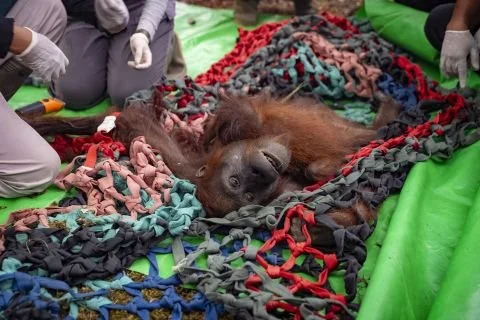
A mother orangutan and her baby have been rescued from a palm oil plantation in Ketapang, West Kalimantan, after fires devastated surrounding forest. Mama Penja was found severely dehydrated and malnourished, with serious burns to both feet.
Mama Penja and her baby, Penja, were rescued on 14 September after being discovered in a palm oil plantation in Penjalaan Village, Ketapang.
The surrounding forests are home to orangutans and have been severely affected by fires, leaving wildlife facing increasing pressure as food and safe forest habitat become harder to access.
When the rescue team arrived, they found the mother and baby extremely thin and weak. Despite the presence of people nearby, the two orangutans were barely moving from their nest.
After Mama Penja was safely sedated with a blow dart, the veterinary team immediately began emergency treatment. She was given intravenous fluids and oxygen before both orangutans were evacuated to a rescue and rehabilitation centre for further care.
Severe burns and signs of prolonged hunger
Further examination revealed the extent of Mama Penja’s condition.
Dr Karmele Llano Sanchez, wildlife veterinarian and executive director of YIARI, described her as severely dehydrated and pale. She said:
“We also found burns on both her feet that had caused the skin to slough off, likely from walking across burning peat soil.”
Her dental condition was also concerning, with significant wear suggesting she may have been forced to rely on unsuitable food sources during a period of scarcity.
“One possibility is that food scarcity forced her to constantly consume tree bark or other unsuitable food sources,” Karmele explained.
But it was Mama Penja’s behaviour as she began to recover from anaesthesia that particularly concerned the veterinary team.
“What I found most heartbreaking was when she began to wake from anaesthesia; she showed no aggression or resistance; she simply searched for food,” Karmele said.
“It was as if she had only one thing on her mind: finding something to eat. That’s just how hungry she was.”
Laboratory tests subsequently revealed that Mama Penja was suffering from anaemia.
“Given the severity of her condition, we could hardly believe she had managed to survive,” Karmele explained.
The veterinary team suspects that prolonged malnutrition, potentially lasting for weeks after fires began affecting her habitat, contributed to her severe anaemia and deteriorating physical condition.
Fires put pressure on orangutans
The rescue highlights the risks faced by orangutans when fires destroy or restrict access to their forest habitat.
YIARI Chairperson Silverius Oscar Unggul said the rescue demonstrates the importance of rapid monitoring and intervention when orangutans are affected by habitat fires.
“These findings demonstrate that when habitats burn and orangutans’ access to forest areas becomes increasingly restricted, they may be driven into landscapes that pose risks to their safety and health,” Silverius said.
“Consequently, monitoring and rapid field responses are crucial to prevent the animals’ condition from deteriorating and to ensure they receive appropriate care promptly.”
For now, Mama Penja’s recovery remains the team’s priority. The veterinary team is working to stabilise her condition, treat her burns, provide nutrition and intensive care, and monitor baby Penja’s health.
The ultimate hope is that both mother and baby will recover sufficiently to return to life in the wild.
To support more urgent orangutan evacuations, donate online via: www.internationalanimalrescue.org/appeal/urgent-fire-crisis-fund